Friday, June 9, 2017

How To Start A Blog Today

Are you looking for a free, easy, step-by-step guide on how to start a blog?
My free guide on this page will show you how to create a blog that is beautiful and functional, all in an easy step-by-step tutorial (with pictures).
Ready to start the simple step-by-step tutorial? Click here to go to Step #1
 
Start your blog
My name is Scott Chow, and I am going to be your guide on this journey to building a successful blog. I have been building blogs and websites since 2002. In that time I have launched several of my own blogs, and helped hundreds of others do the same.
I know that starting a blog can seem overwhelming and intimidating. My free guide was designed just for beginners, and requires only the most basic computer skills. So whether you’re 8 or 88, you can have your blog ready to go in less than 20 minutes.
I am not ashamed to admit that when I was first learning how to build a blog I made a ton of mistakes. You can benefit from more than a decade of my experience so that you don’t repeat these same mistakes. I created this free guide so that anyone can learn how to blog quickly and easily. And if you get stuck at any point, please send me a message and I will do my best to help you!
 
Skip the rest of this introduction and start building your blog!
 

What is a blog anyway?


In short, a blog is a type of website that focuses mainly on written content, also known as blog posts. In popular culture we most often hear about news blogs or celebrity blog sites, but as you’ll see in this guide, you can start a successful blog on just about any topic imaginable.
Bloggers often write from a personal perspective that allows them to connect directly with their readers. In addition, most blogs also have a “comments” section where readers can correspond with the blogger. Interacting with your readers in the comments section helps to further the connection between the blogger and the reader.
This direct connection to the reader is one of the main benefits of starting a blog. This connection allows you to interact and share ideas with other like-minded people. It also allows you to build trust with your readers. Having the trust and loyalty of your readers also opens up the door to making money from your blog, which is something I discuss later in this guide.

Should you start a blog?

One of the misconceptions about starting a blog is that you need to be a great writer to be successful. Nothing could be further from the truth. People read blog sites to get a personal perspective on things, so most bloggers write in a very informal and conversational style.
In addition, you don’t need to be an expert on your topic in order to have a successful blog. For example, readers of a cooking blog don’t want to read a textbook from a food scientist, they want to hear the experiences of someone who has actually cooked some real meals, mistakes and all.
To be successful as a blogger there is really just one requirement: a passion for your topic.
At its heart, blogging is about sharing your knowledge with the world. Choosing a topic that you are passionate about makes the process of starting a successful blog so much easier. Writing about more than one topic is totally fine too. As long as you are writing about things that you are genuinely interested in, your passion will shine through and keep your readers interested.
So why would you go to the trouble of blogging? There are a few reasons:
  • Make money from home. Blogging can be quite lucrative if done correctly. The top bloggers in the world obviously earn quite a bit, but even a part-time blogger can expect to make a nice profit if things are done correctly. The best part about it is that blogging is a form of passive income, since you can spend just a few hours a week writing a blog post and then continue to make money from it long after the blog post is written. I go into much more detail on how to blog for money later in this guide.

  • Share your story. A blog allows you to have a voice and be heard. You can share your story with the entire world if you so choose. One of the most common ways blogs are used are as a diary where the blogger writes about their daily experiences so that friends, family, and others can all be a part of their lives.

  • Recognition for yourself or your business. No, you probably won’t have paparazzi following you around because of your latest blog post. But a successful blog can gain you a ton of recognition in your respective field. Many bloggers are known as experts just because of their blogs, and some have even gotten book and movie deals based on their blogs.

  • Find a community. Blogging at its heart is interactive. You write a blog post and people comment on it. This is a great way to connect with people who are interested in the same things as you are. Blogging allows you to teach these people based on your experience, and it gives you the opportunity to learn from your readers as well.
The good news is that the internet is exploding with growth right now. More people than ever are online. This explosion in growth means more potential readers for your blog. In short, if you are thinking about starting a blog then there is no better time than right now.

How to Start a Blog in 6 Steps

Learn how to create a blog in about 20 minutes following these steps:
  1. Pick a blog name
  2. Get your blog online
  3. Customize your blog
  4. Write & publish your first post!
  5. Promote your blog
  6. Make money blogging

Step 1: Pick a blog name

The first step to finding a good blog name is choosing your topic.
If you’re not sure what to blog about, there are a few ways to find a good blog topic:
  • Hobbies & passions. Hobbies or other interests you are passionate about are a great place to start. Cooking, travel, fashion, sports, and cars are all classic examples. But even blogs about more obscure hobbies can be successful, since the your audience is literally anyone in the world with the internet.

  • Life experiences. Everyone has lessons they have learned through life experience. Sharing this knowledge can be incredibly helpful to others in similar situations. For example, I recently helped a woman start her blog about being a fireman’s wife. She has a lot of experience and knowledge to share with others about this topic, and it has helped her connect with others in similar situations.
    Think about the things you have experienced in life. This could be related to your family (example: a blog about being a stay at home mom), work (a blog about experiences dealing with clients), or other life experiences (a blog about dealing with a troubling time such as a disease or divorce, or about a happy time such as preparing for a wedding or a birth of a child).
     
  • A personal blog. A personal blog is a blog all about you. This will include a variety of topics, from things you do on a daily basis, to random thoughts and musings. This is a great way to share you thoughts with the world without having to stick to just one topic.
Once you have a topic it’s time to choose your blog name.
A good blog name should be descriptive so that potential readers can instantly tell what your blog is about just from the name.
If you are blogging about one specific topic then you will definitely want to include that in some way in your blog name. Try not to get hung-up on just one word though. For example, a cooking blog doesn’t necessarily have to have the word “cooking” in it. The words “food”, “recipes”, and “meals” would also let people know that your blog is about cooking.
If you are planning to create a personal blog where you discuss a variety of topics then I recommend using your name, or some variation of it, since your blog is all about you. For example, I own the blog scottchow.com. You can also add your middle name or middle initial if you find your name is already taken. Or you could use a variation like “Scott Chow Blog” or “Blogging with Scott”.
Once you have some blog name ideas you will need to choose a domain extension.
A .com domain extension is the most preferred, but .net or .org work as well. It is also important to note that for the purposes of a blog domain you cannot have any spaces between words. So “Blogging with Scott” becomes bloggingwithscott.com
Now that you’ve got your name and have picked an extension it’s time to make sure that no one else has already registered the same name:

                        See if your blog name is available


Note: You cannot use any spaces or punctuation other than dashes in a domain name.

If you find that the name you wanted is already taken there are a few things you can do:
  • Try a different domain extension. If the .com version is already registered you may still be able to get the .net or .org version of your blog name.
  • Add small words. Words like “a”, “my”, or “the”. For example, this site is called TheBlogStarter.com instead of BlogStarter.com.
  • Add dashes between words. For example, scott-chow.com

Step 2: Get your blog online

Now that you’ve got a name picked out it’s time to get your blog online. This might sound hard or technical, but the steps below will walk you right through and make the process easy.
To get your blog up and running you need two things: blog hosting and blogging software. The good news is that these typically come packaged together.
A blog host is a company that stores all of the files for your blog and delivers them to the user when they type in your blog name. You must have a blog host in order to have a blog.
You also need to have the software to build your blog. In this guide I will be showing you how to build a blog using the WordPress blogging software, because it is the most popular, customizable, and easiest to use.
post-itThe blog host I recommend, and the one I show you how to use in this guide, is BlueHost. I personally use BlueHost and I recommend them for all new bloggers because:
  • They will register your blog name for you for free, making sure no one else can take it.
  • They offer a free, simple installation of the WordPress blogging software (which I show you how to use in this guide).
  • They have been recommended by WordPress since 2005 and currently host over 2 million blogs and websites.
  • They have helpful 24/7 customer service via phone or web chat.
  • They have a money-back guarantee if you are unsatisfied for any reason.
Use any BlueHost link on this site to make sure you get the special discount price of $2.75 per month. BlueHost compensates me when you purchase through my link, so my services are free of charge to you! In fact, if you have any trouble at all setting-up your blog with this tutorial, just contact me and I will do it for you.

1. Click here for the special $2.75 per month rate on BlueHost and then click “get started now”.

2. Select your plan. I recommend that new bloggers get the basic plan. Click “Select” to choose your plan.

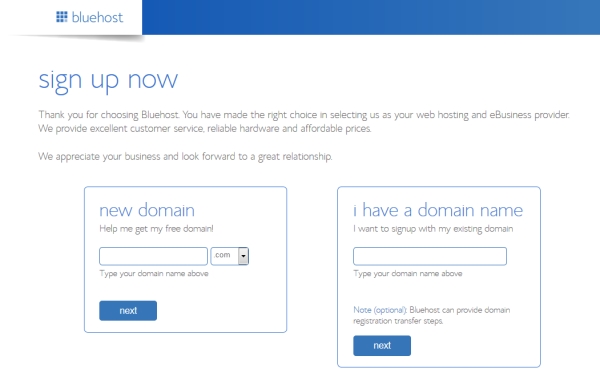
3. Type in your domain name in the left box and then click “next” to start the registration process.

  • If you already own a domain name and want to use it for your blog, type your existing domain in the right box and then click “next”. Only use the right box if you have previously paid to register a domain!
domain-registration

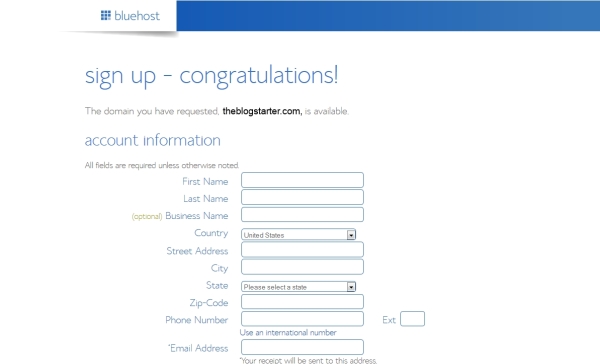
4. Fill out your billing details on the registration page.
bluehost-registration

5. You will also need to choose your hosting package and options.

  • The 36 month package gets you the lowest monthly rate, while the 12 month package has a lower up-front cost. Either is a good choice.
  • uncheck the boxes next to the other products when I sign-up. You can always get these products later if you decide you need them.

6. You will then need to create a password for your account. Once you do that your blog software will be automatically installed. Click “Log Into WordPress” to be taken to your blog.

You should also receive an email with your blog log-in details. (NOTE: The login details for your blog will be different than for your BlueHost account.)
Having trouble installing your blog? Get help here.
 

Step 3: Customize your blog

Logging in

To start with, you will need to login to your blog. Go to http://www.yourblog.com/wp-admin to bring up the login screen (replace “yourblog.com” with your domain name). If you are unsure of your login name or password, check the email that was sent to you from BlueHost that has this information.
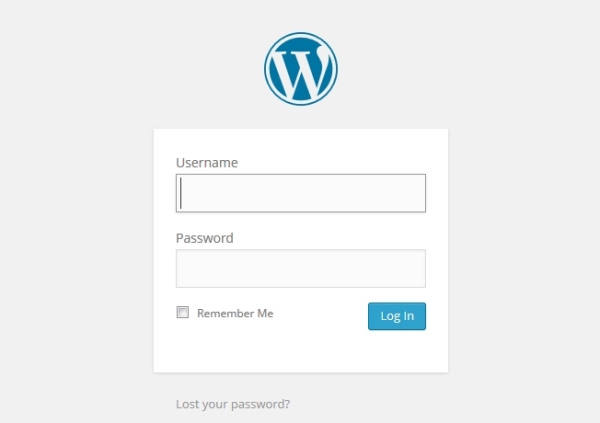
wordpress-login

Changing your blog design

Once you login you will be in the WordPress administrator area. This is where you can make any changes you want to your blog.
Everyone has a different idea of how they want their blog to look. One of the great things about a WordPress blog is that you can change your entire layout and design with just a few clicks.
In WordPress, blog layouts are known as “Themes”. What is a blog theme? Themes control the entire design of your blog. To change your theme you are going to click on the “Appearance” tab on the left menu.
You will see several themes are already installed on your blog: Twenty Seventeen, Twenty Sixteen, etc. These are well-designed, clean-looking themes that can work for just about any type of blog. In fact, many of the world’s top bloggers use one of these themes.
Unless you have a very specific design in mind for your blog, I suggest you use one of these themes to start with. For our example, let’s use the “Twenty Twelve” theme. In order to activate the theme on your blog, hover over the theme and click the “Activate” button. That’s it! You have changed the entire design of your blog with just one click!
If you don’t like any of the themes that are already installed you can easily choose from thousands of other free themes. To install a new theme, click on the “Appearance” tab on the left menu and then click “Add New”.
This is the theme search screen. By clicking the “Feature Filter” you can search by color, layout, and more. Check the boxes that you want and then click “Apply Filters”.
Now you can browse the themes that have the characteristics that you want. When you find one that you like click the blue “Install” button.
Once the theme is installed click “Activate” to activate the theme on your blog. To see your new theme in action, go to your blog and take a look!
Changing your theme is the simplest way to customize your blog, but there are lots of of other customizations you can do. Check out my full post on customizing your blog for an in-depth step-by-step guide. You can also watch the video at the end of this guide to see me completely customize a blog from scratch.
 

Step 4: Write & publish your first post!

Now that your blog is up and running it’s time to actually do some blogging!
Go to the left menu and click on “Posts”.
You will see there is already a post there. This is a default post on every new WordPress blog, and we don’t need it. To delete it click “Trash” just under the post.
To begin writing a new post, click the “Add New” link.
You are now on the post editor screen. Enter the title of your post in the top box and then begin writing your post in the lower box.
If you would like to add a picture to your post, click on the “Add Media” button and click “Select Files” to upload a picture from your computer. You can make adjustments to the picture size on the next screen. When you are ready click “Insert into post” to add the picture.
Once you have finished your post just click the “Publish” button on the right side of the screen to publish it.

Publishing Your Blog

Even after you have written a post your blog may still be showing a “Coming Soon” page.
When you are ready to make your blog public just click the link near the top to remove the “Coming Soon” page.
Congratulations! You now know how to publish content on your blog!

Step 5: Promote your blog

Creating a well-designed blog and writing great content is just the start. In order to get readers for your blog you will need spend some time promoting it, especially when you first start.
One of my favorite ways to get readers to my blog is to post links on my social media accounts like Facebook and Twitter. This is great, because not only do your friends see the link, but if your friends share the link with their friends it automatically multiplies your readers. If you have created high-quality content on your blog then social media is a great way for your blog to go viral.
In addition to getting new readers to your blog, you will also want to make sure your current readers are coming back. This is where email marketing plays a big role. By collecting the email addresses of your visitors (with their permission of course), you can then notify them when you post something new on your blog. This keeps people coming back to your blog, which not only gives you more readers over time, it also allows you to build a closer relationship with your readers.
Email marketing is too big a topic to cover well here, so I created a separate guide to email marketing for those who are interested (hint: every blogger who wants more readers needs to read this guide).
For more tips on promoting your blog make sure to check out my in-depth guide to blog promotion.
 

Step 6: Make money blogging

Once you have put in the effort of creating great blog content and promoting your blog, making money from your blog is actually the easy part.
There are several ways you can make money blogging, from selling your own products or services, to getting paid to write reviews of products on your blog. But the easiest way to make money from your blog is to sell advertising space.
Once you have a popular blog, advertisers will be hounding you for the opportunity to advertise. The best way to take advantage of this situation is to use Google Adsense. They find the advertisers for you and all you have to do is place the Google Adsense code on your blog to start running ads. Google Adsense takes all of the hard work out of the process and just cuts you a check.
I go into the full details of how to set up Google Adsense for your blog here. For more information on making money from your blog see my full guide here.

Need more help?

I hope this guide has answered any questions you had on how to start a blog, but if any of the steps were unclear to you, you can find a more detailed version of each step by using the menu at the top right of this page (or at the bottom of this page if you’re on a smartphone).
How do I start a blog? You can watch me build and customize a beautiful blog from scratch here:

The video above should answer a lot of questions you might have about getting your blog set up and customized, but more specific tutorials can be found on my blog page. Here are some of the most popular tutorials from my blog:
  • How to add custom logos or images
  • How to get readers to subscribe to your blog
  • How to see how many people are visiting your blog
  • How to automatically share your new blog posts on Facebook and Twitter
  • How to link to other sites from your blog
  • How to change text size and color
  • How to make your blog private
Contact me if you have any issues at all and I will personally respond to your email.
The step-by-step guide on this site should give you everything you need to get started, but if you run into some issues, or just want some personalized advice, please do not hesitate to contact me at any time. Blogging is my passion, and I would love to talk with you about it!

Wednesday, April 19, 2017

Samsung Galaxy S8, S8+ Launched in India Starting at Rs 57,900


Samsung Galaxy S8 and S8+ have been launched in India at a price of Rs. 57,900 and Rs 64,900 respectively. The Galaxy smartphones come as the successor of the Samsung flagship range. The smartphones with ‘Infinity Display’ differ in screen size and battery power and weigh 155 grammes and 173 grammes respectively.
Samsung Galaxy S8 sports a 5.8-inch Quad HD+ Super AMOLED curved display. The display comes with a 1440x2960 pixel resolution and an 18:9 aspect ratio.
In contrast the Galaxy S8+ features a 6.2-inch screen sharing similar specifications.

amsung Galaxy S8 and S8+ is powered by Samsung’s own Exynos 8895 SoC (2.35GHz Quad + 1.9GHz Quad) processor.
The phones come with a 4GB RAM and 64GB of internal storage option, which is expandable up to 256GB using external microSD card.

The Galaxy smartphones sport 12-megapixel rear cameras with 'Dual Pixel' technology. The camera features include optical image stabilisation and f/1.7 aperture.
In the front, the smartphones don 8-megapixel cameras with autofocus.
Samsung Galaxy S8 and Galaxy S8+ will come with 4G LTE, Wi-Fi, Bluetooth v5.0, USB Type-C, NFC, and GPS connectivity options.
The phones come with sensors like accelerometer, barometer, gyroscope, ambient light sensor, magnetometer, heart rate sensor and proximity sensor.
oth the Galaxy smartphones support Samsung Pay, MST and NFC connectivity.
Galaxy S8 and S8+ are powered by 3,000 mAh and 3500 mAh battery respectively, along with wireless charging and fast-charging support.
Samsung Galaxy S8 and S8+ will be available on Flipkart from May 5 at a price of Rs 57,900 and Rs 64,900 respectively. The pre-orders for the phones start from 3 pm today on Flipkart. Samsung is offering free wireless charger along with the smartphones on pre-booking.

Tuesday, April 18, 2017

How To Create a Free Video Blog (or "Vlog")

Here's How:

  1. First, you'll need a reason, or a theme, for your video blog. Video blogs can have many different applications, and can be created for various personal and professional reasons.
  1. Find a web host for your video blog. There are many free web services that will host your video blog and simplify the vlogging process. I generally recommend YouTube or Vimeo for hosting videos. You can then use the channel page on the video site as your vlog, or you can create a separate blog site - through wordpress or another service - to embed your videos.
  2. Name your video blog. The content is more important than the name, but having a catchy yet easy-to-remember title can attract more viewers and keep them coming back.
  3. Prepare some content. You’ll probably be able to generate a lot of interest from your audience at first, but if you don’t add new content regularly people will lose interest and stop checking in. So, before you go live with your video blog, make sure you have enough content to keep it going for a little while.
  1. Post your videos. Now you can upload your videos to the web and post them to your video blog. You can improve the visibility of your videos by adding good titles, tags and description.
  2. Curate videos. Video curation is the easiest way to put together a great video blog. All you have to do is find videos that other people have produced that will be of interest to your audience, and post them on your vlog.
  1. Promote your video blog. To gain an audience for your vlog, you'll need to let the world know that it exists! You can do this through blog aggregation sites, search engine optimization and good old fashioned self-promotion (i.e. sending out an email to all your contacts).
  2. Make money from your video blog. Depending on the content, and where you choose to host your video blog, you may be able to make some money from your videos.
  3. Keep it up! To have a successful video blog you'll need to continuously create and update your content. If you're creating videos about a topic that you love, keeping an up-to-date video blog should be a joy and not a chore

Sunday, April 16, 2017

List Of 10 Free Blogging Platforms For Creating Blogs

Are you looking for the list of free blogging platforms to launch a new blog?
Whether you know it or not, blogging is one of the best ways to make money online. You don’t have to be a marketer and you don’t need any special skills to make money blogging. This is the major reason most people are now starting blogs by their own. I’m the live example of the one who makes money from online and I’ve been successfully making money from several blogs for the last 5 years now.
So making money from blogs is not a fake or spam stuff. Anyone who is willing to put some hard work and consistent efforts can make money from blogging.
Generally blogs are available in two forms, one is free and the other is self-hosted blogs where you have to pay money. Both of them have their own pros and cons. Free blogging sites are free to use though you won’t have full control over your sites whereas in self-hosted sites you have to pay money for domain and hosting to run your sites (and you’ll have full control on your sites) .
If you are just starting out your blogging journey, you can start with free blogs. There can be lots of reasons why you want to try your hands on free blogging sites first. The most obvious reason could be the cost. With free blogging sites, you won’t be paying a single penny for your domain name and hosting space.
Another reason could be, since you are just starting your blogging career, it’s a great idea to get used to the blogging and how to work on blogs. Once you get used to blogging and had working knowledge about a niche, you can move to a self-hosted blog where you have to pay money. You have to make a small investment when you move to a self-hosted blog on WordPress or any other blogging software. There you will need to buy a domain name, WordPress friendly web hosting, premium themes and plugins for your WordPress blog.
If you are short of funds, you could ignore the plugins and themes investment for some time. But for buying a domain name and web hosting from a top web host, you need to make a small investment of $60 to $70 every year at least.

How Will Be Your Blog Address With Free Blogging Sites?

Every blog needs a domain name. If you are starting a blog, you should be giving top priority to choosing a good name for your sites. Getting a domain is also free when you are using free blogging platforms.
On free blogging websites, you will be getting a sub-domain as your blog address. If I try to registering bloggers passion as my blog URL on WordPress.com, my ultimate blog URL in that case will be bloggerspassion.wordpress.com (If it happens to be available). So WordPress.com will be added with each blog which is created for free on WordPress.com.
The same thing applies when you went on to create blogs on other free blogging platforms like blogger.com, weebly.com and blog.com etc. So the general blog syntax for your blog address will be abc.blogspot.com or abc.wordpress.com where abc is your blog name.
Here are few pros and cons of using free domain names through various free blogging platforms list.
Pros:
  • You will be getting a free domain name for lifetime (unless you violate rules)
  • Wide range of free domain names (you’ve to be creative to come up with memorable domain names)
Cons: 
  • It looks odd with the .blogspot.com or .wordpress.com
  • Your audience might think you are not serious about blogging
  • You don’t know when it will disappear
  • Free blogging platforms add cheap look to your sites often!

Some Important Facts About The List Of Free Blogging Websites

  • First of all, you will have no control on your blog address. You will be at the mercy of your free blog host. They can delete your free blog without any prior notice if they find you are doing anything against their TOS. So make sure to know about this fact before finding about creating a blog using the list of free blogging sites that you are going to explore on this page.
  • Most of free blog hosts will allow you to add content on your blog in the form of blog posts and pages. You can easily add images, videos and other kind of media elements on your blog.
  • You cannot upload a theme or template of your own with most of free blogging sites. But on Blogger.com, you can upload templates of your own and also can upload templates that are available on other blogger template websites.
  • These free blog hosts will give you enough space to write your blog posts in normal. But if you start spamming these blogs with hundreds of automated blog posts on daily basis, you will come to know about your monthly blog post limit on these websites very soon.
  • You will have no access to the plugins on most free blogging platforms like Blogger. If you are on the other hand using WordPress as your blogging platform, you will have access to over 20,000 plugins ranging from SEO to increasing your AdSense earnings.
  • You will have very few chances of making money with free blogs created on most of these free web hosts. With most, you cannot do much monetization wise. It will be your blog post area only where you can add links for making money. Most free blog hosts will not allow you adding any java Script or PHP code on your blog. Blogger.com is an exception to this. There are lots of free blogging sites even that used to run their own monetization widgets on your blogs and you have no control to remove them (Paying money to them will be the only option).
So enough about the importance of having free blogging platforms to star blogs. Here is the ultimate list of free blogging sites that you can use for creating free blogs of your own (the following list of blogging platforms are in no order, means, every blogging platform has its own pros and cons).

1. Blogger.Com (BlogSpot)

The list of free blogging sites definitely starts with Blogger platform. One of the most preferred and widely used free blogging platforms is Blogger. When it comes to free blogging sites, Blogger is the one you can’t miss out. If you are searching for a free and reliable blogging platform, Blogger is the perfect choice for you. Blogger.com is not only one of the most popular blogging websites and it is owned by search engine giant Google. You will be getting the most of the features you can expect when hosting a domain on your own hosting.
The themes at Blogger look really beautiful, plain and simple. And Blogger supported blogs are by default search engine friendly so you can just focus on creating better content for your readers to increase your overall organic traffic.
The only limitation using Blogger blogging platform is that you will have no control over your domain name and ultimately it’s just a sub-domain. You can create blog posts, add images and videos to them with ease and can even monetize your blog with most of monetization programs available on internet like Google Adsense and Amazon etc. You can find the list of websites for making money online from your blog here.
You can customize your blog design to great extent. There are thousands of free templates available on Blogger platform and you can design your blog anyway you like. You can create pages, multi user blogs, private blogs and Blogger.com is currently available in 41 languages. Click this link to know more in detail about Blogger.com features.
I myself started my blogging journey with Blogger.com. Best thing about Blogger.com is that it’s quite easy to use compared with other blogging platform available on Internet. You can use blogging platform from Blogger.com on your custom domain even by mapping it. Majority of the bloggers still use Blogger platform to start their own websites or blogs not only because its free but it gives you great functionality.
Must Read: Blogger Vs WordPress: Why Self Hosted WordPress Blog is Better Than Blogger
Make good use of Blogger to get AdSense approved fast. There’s common point among the most bloggers that, getting AdSense approval is really faster when you use Blogger as both Blogger and AdSense are controlled and managed by Google.

2. WordPress.Com

WordPress is also one of the most reliable and widely used free blogging platforms. After Blogger.com, it’s WordPress which is the most used and most powerful content management system for bloggers. You can use WordPress for creating personal, professional and I would say blog of any type. You will get most of the features that you were enjoying on Blogger.com but you will have very few options when you think of monetizing your free blog (sub-domain) on WordPress.com.
Over 17% of the websites worldwide are hosted on WordPress content management system. This is indirectly telling the importance of using WordPress.com to create free blogs. If you want to start your blog on a self hosted CMS, you can do that too using WordPress.org. One of the widely used CMS in the world and almost every industry blogger uses WordPress.org to run their websites.
You can use WordPress blogging software on your custom domain by downloading it from WordPress.org website and uploading it on your purchased web space. It does not take much time in installing WordPress on WordPress friendly web hosts. If you don’t know how to do it, you can use Bloggers Passion free WordPress Installation service.
There are some limitations that should be in your mind if you are thinking of using WordPress for creating your first free blog:
  • You will just get a sub-domain with them
  • You cannot install themes or plugins that are not in WordPress official directory. You can access WordPress free themes and plugins directory from here and here.
  • You cannot use Google Adsense, Amazon or any other monetization program that asks you add certain java Script or PHP code into your blog.
But you can get free from these and many more limitations if you went on to Start a Self-Hosted WordPress blog from Scratch. By using a self hosted blog, it’s not only easy to manage your sites, but you can also make money blogging if you put some bucks on SEO, content writing or design.

3. LiveJournal.Com

Live Journal is available in free and paid version. You have to pay money if you want to keep your LiveJournal blog from their free advertising. You will be getting the features like multiple author blogs, polls and calendars, commenting and it has lots of social media features which differentiate it from other free blogging websites.
Over 16 million people are now using LiveJournal to create their free blogs. You can also blog in several languages including Dutch, French, German, English so if you are not good at English and want to try these languages, you will feel lucky using LiveJournal free blogging site.
Here are few notable features of free blogging site LiveJournal.
  • Video Uploading
  • Photo Uploading
  • Private Message Sending
  • Public Message Posting
You can know more in details about LiveJournal feature for free and paid account type from here.

4. Tumblr.Com

Tumblr is a micro blogging website like Twitter and Facebook. Tumblr is one of the fastest glowing websites on the internet and it looks like a mixture of blogger, Facebook and Twitter.  Use Tumblr to create free blogs if your site is more about the visuals. Tumblr gives you everything to make your images look visually appealing and you can show images, videos and music in anyway you want. They have lots of unique feature that makes them the unique choice of too many bloggers:
  • Hundreds of ready to use themes
  • You can post on your blog directly from your Email box
  • You can add pictures of even high-resolution here
  • 10’s of ready to use third-party apps
  • Track your blog readers through Google Analytics
  • Publish updates to your Facebook account
  • No limit on how many people can contribute on your blog
  • You can schedule your blog posts
  • You can create a theme of your own
  • You can post almost anything on Tumblr
  • You can keep your posts public and private
  • You can convert your posts into audio posts
  • You can use your own custom domain
  • Automatic update on Twitter about your latest posts
Use this link to know more in detail about why you should choose Tumblr over other blogging platforms. You can repost, reshare, reblog anything that you find useful on Tumblr community this leads to get you more Tumblr followers without actually spending time in content creation.
Other people can also reblog your blog posts, images and videos leaving you with more followers and giving you much exposure to reach wider audience.
From the list of free blogging sites mentioned in this page, Tumblr is one of the finest platforms to create a site that is clutter free and mostly content oriented.

5. Blog.Com

Blog.com is one more truly professional option for blogging which is available in free and premium version. You will get facilities like multi author blogs, integration with popular social media websites, tracking your blog stats through Google Analytics and selection of theme from its theme gallery. If you have some funds you can use Blog.com premium features, you can have all of its premium features including a domain name. Here is the list of premium features from Blog.com with their cost:
  • You can keep your blog free of ads for $30.
  • Although they provide 2 GB storage space to their users for free. But if you need more you can get that by paying extra money. Their extra storage space feature starts from $20 per year.
  • You can use your own domain name for your blog that you have created by paying $18 every year. You can register any .com, .net, .info or any other domain or even can map any of your existing domain names with your blog.com blog.
  • You can customize CSS by paying $15 every year.
  • You can remove limit on number of authors on your private blogs by paying $25 every year.
  • You can use their premium theme gallery by paying $70/year.

6. Weebly.Com

Weebly is a California-based company which was started in 2006 and in 2007; it was named amongst Best 50 Websites by Times. Weebly is popular free blogging platform and used by many people to create their free blogs because of its versatility. They are currently hosting personal websites and blogs of over 12 million people.
You can publish your content on Weebly sub-domain or on your custom domain and you will not be charged anything for domain mapping unlike other web hosts in the industry. You can also drag and drop items to create menus, pages, categories etc. using Weebly to create free blogs is a fun and you won’t find it hard to maintain your blogs.

7. Penzu

Want to write your blogging/IM/Life or Personal thoughts privately online? Try Penzu. It is a free blogging site that allows you to post various journals on your blogs. You can upload unlimited images as it provides unlimited storage to its users. Here are few great features of Penzu.com
  • Smartphone Access
  • Multiple Journals
  • Auto saving feature
  • Easy to use navigation
  • Rich text formattiing
  • Search, tagging and military grade encryption to save your files
  • Auto logout
  • Unlimited storage
You can use 3 types of journals using Penzu blogging platform. Daily Diary (public can read your content), Expressive Journal (private), and Travel Journal (especially designed for travelers).
Here’s the link to start a free blogging site using Penzu.

8. Squarespace

The list of free blogging sites won’t be complete without naming Squarespace. It is one of the easiest ways to create a free website, Squarespace is a great website builder that has almost everything you are looking for. It is the most effective blogging platform for photographers, online retail store owners, bloggers and musicians. It will make your site not only look awesome but their templates make your site stand out from other blogs easily.
Here are few features of Squarespace free blogging platform.
  • Built-in Mobile Websites
  • Style editor
  • Install multiple templates at once
  • Appealing templates
  • Free Typekit fonts
  • The ability to add custom CSS
Click this link to start building your free site on Squarespace.

9. Svbtle

You can create your own domain name with your own hosting using Svbtle. You can do almost everything that gets done on Blogger, WordPress.com using Svbtle free blogging platform. You’ll have less chances to change your design, and if you’re a minimalist you will love writing using Svbtle.  Here’s the link to launch your free blogs using Svbtle.

10. Edublogs.Org

As the name suggests, Edublogs is the perfect blogging platform for education related blogs. If you are a college student or a professor, want to make a site on your own for free, this is the perfect choice to select from the above list of free blogging sites.
You can create blogs as a student, as a teacher or as an institution on this free blogging site. Currently they are holding more than one million education blogs on their free blog hosting. You can know more in detail about why you should choose Edublogs for creating for your first education blog here.
There are a lot more free blogging sites available that will help you start your own free blogs. I’ve to also mention about another free blogging platform called “Ghost“.
Ghost is an open sourced blogging platform and is useful for all users who want to quickly set up a basic blog. You have to simply download the Ghost software and install it on your own web server to start working on it.  Ghost can be completely customized in design to suit your needs and your brand.
Ghost free blogging platform gives a unique look to your blog’s design. Its new approach with a lot of packages is ideal use for all kind of bloggers. Ghost also has many amazing features like split-screen editor with Markdown syntax on the left and a live preview on the right allows you to type and format your writing on the fly.
Although there are a lot of common problems you might face with the list of free blogging sites mentioned in this page (that includes, constant 504 and 502 errors, pages getting deleted, slow loading page etc). But again it depends on blog to blog, each blogging platform is different and all of them have their own set of pros and cons.
So make sure to know the primary fact before starting a free blog that it’s not a cakewalk. But if you really want to share your thoughts and create a following for yourself online, using free blogging sites mentioned above is a great step.
Final thoughts about the list of free blogging platforms
I hope I’ve suggest the list of best free blogging sites that allow you to create your own blogs to share your thoughts and connect with other people online.
As I mentioned in this post, there are a lot of free blogging platforms available out there. Choosing a free blogging site is not an easy task and you can’t try them all at once. So first know your blogging needs, and choose your blogging platform according to your profession.
For instance, if you post more images rather than text or videos, Tumblr works really great. If you are a small business owner, WordPress is the right choice as it will not only give you full control over your sites but helps you increase your website visibility in search engines. If you want to make money blogging, try Blogger and if you are a student, and want to start something awesome, try Edublogs. If you want to share your travelling experience, you can use travelpod.com, a blogging platform created especially for sharing travelling experience.
If you are a beginner and searching for ways to make money from blogs, I would strongly recommend you to try either Blogger or WordPress from the list of free blogging sites mentioned above. The reason is, these two blogging platforms are reliable, faster, secure and you can easily migrate from one to another.
Must Read: How to Migrate from Blogger to WordPress Without Losing Google Rankings
Once you start making money or getting more online reputation, you can then switch to self-hosted blogging platforms such as WordPress. You can have full control with these blogs and you can make a lot more money with self-hosted blogs because of flexibility and access to wider tools.
Let me know the best free blogging site you would recommend to a newbie? I’m sure you must have already tried your hands at some of these free blogging sites. It would be great if you could share your experience and your favorite from this list in the comments section.

LAST UPDATED ON APRIL 1, 2017 BY NISCHAY JAIN LEAVE A COMMENT How To Start a Blog in 2017 (Step by Step Guide)


So, you want to start a blog huh? Great idea!
Well, starting your own blog is not a complicated thing nor its expensive. In fact, more than 50,000 blogs are created everyday for fun or profit.
It seems that just about every person or business have a blog these days, I know you want to learn how to start a blog quickly, that’s why you are here, right?
It’s never been easier to set up a professional looking blog but if you’re like most people you may not know where to get started.

Today is your day! I’m going to walk you through the most comprehensive step-by-step guide on how to start a WordPress blog in 20 minutes (or less).
And if you get stuck with anything, send me an email and I will do my best to help you out.
Every single day I help someone to get their blog started and I seriously enjoy doing it.
Since I believe in transparency, if you use this guide to set up your blog, I will get a small commission from the web host at no extra cost to you (in fact, you will save money and get a free domain).
So if you’re asking me for help you aren’t annoying me, rather you are helping me to make a little extra.
It’s a true win-win so don’t hesitate to take advantage. I look forward to hearing from you.

How to start a blog (In 9 easy steps)

You are mere nine steps away from launching your very first blog:
  1. Choose your blogging platform
  2. Get a domain name for your blog
  3. Choose your hosting company
  4. Setting up your blog
  5. Installing WordPress on your blog
  6. Learning WordPress basics
  7. Selecting your WordPress Theme
  8. Installing plugins on your blog
  9. Write Your First Blog Post
Let’s Get Started!

Step 1: Choose your blogging platform

What blogging platform should you use for your first blog? Although there are plenty of options out there but I would recommend WordPress.org blog without a second thought.
Because it’s free, easy to set up, versatile (with oodles of cool plugins to beef up your blog) and well supported. (At the time of writing this, there are more than 72 million WordPress blogs on the Internet)
There are various other popular blogging platform options available such as Blogger, Tumblr, Squarespace, Wix and many other but you’ll want to keep a few potential pitfalls in mind if you decide to go with one of these platforms. In many cases:
1. Ugly Looking URL
The web address of your blog will be long and hard to remember, typically it will look like this:
  • yourblog.blogspot.com
  • yourblog.wordpress.com
  • yourblog.tumblr.com
As you can see it doesn’t look catchy and branded at all.
2. No Customization
You are limited to the design themes and styles they offer you, you cannot use any of the free plugins or themes available to a self-hosted blog.
WordPress themes helps you in making your site more beautiful and plugins help you extend the functionality of the blog, but if you go with free platform then you will not have access to any of these.
3. You can’t monetize your blog
You’re not allowed to advertise on your blog, which makes it much harder to make money from blogging.
You cannot do affiliate marketing on free blogs, some of them prohibit Google Adsense and heck they may even place their own ads on your blog.
I have already explained in detail about best blogging platforms in the past, if you need more help to make choice regarding your blogging platform, give it a read.
But the general rule of thumb is to create a self-hosted WordPress blog where you don’t have any sort of limitations.
4. You don’t own your blog
I know it sound silly at first, but it’s true that you don’t actually own your blog, the blogging platform does.
Since your blog is hosted on someone else’s web property (e.g. WordPress.com, Tumblr.com or blogspot.com) and if you violate their terms of service (even by accident) or If the company’s server mistakes your blog for a spam, they can shut you down any time if they want so.
And guess what – you cannot do anything if that happens.
I run all of my blogs on WordPress because it’s flexible, ease of use and powerful.

Step 2: Get a domain name for your blog

The domain name for this blog is blogscart.com, If you type that domain name into an internet browser anywhere in the world you will be sent to this site.
You may or may not already have a domain. If you already have a domain registered, you can skip this step.
If not, keep on reading (I will show you how to setup in both cases later on).
You have to do some research before you choose a domain name for your blog. You should pick something that fits your industry and on the same time it’s unique as well as descriptive, so that your audience will immediately know what your blog is all about.
Here are some tips to consider when choosing a domain name:
  • Don’t include hyphens, numbers, obscure terms or confusing strings of words. It confuses people and it makes it hard to explain the domain to others.
  • Make it easy to type. There’s no need to go with creative misspellings, it doesn’t make any sense and rather it confuses people.
  • Make it pronounceable. The goal is to make it easy to remember and easy to share!
  • Keep it short.
  • Don’t go with other company’s brand names or slogans which are trademarked. As they will come after you and shut your blog down.
  • If you’re not sure what to use, your name is a safe bet to get started.
  • Read more tips here if needed.
Keeping this tips in mind, you should put some thought into your domain name, but not too much.
If you come up with something you like within 5 minutes, give it a go.
You may find that the domain name you want is already taken with the .com extension, this happens to all of us.
But don’t give up –  it’s 2017.
There are over 250 different domain extensions to choose from such as .co, .co.uk, .co.in, .net, .org etc.